

Mahāyāna Buddhism : ค้นหาหนังสือธรรมะ หน้า 4 / 5
หน้าหนังสือทั้งหมด
84
Bibliography of Buddhist Studies
Bibliography
Dutt, Nalinaksha. Mahayana Buddhism. Delhi: Motilal Banarsidass, 1978.
Geiger, Wilhelm. “Dhamma and Brahman.” Zeitschrift flour buddhismus (1921): 73-83.
Gombrich, Richard. “The Buddha’s
This bibliography encompasses significant scholarly works in Buddhist studies, offering insights into various aspects such as the early Buddhist philosophy, the concept of Dharmakāya, and teachings of
195
Understanding the Three Characteristics of Buddhism
Characteristics (tilakkhana), consisting of impermanence
(aniccata), suffering (dukkhata), and non-self (anattata). This
truth stands behind all living beings in this world.
The truths of the Law of K
This text explores the Three Characteristics of Buddhism—impermanence, suffering, and non-self. It discusses how misconceptions among children regarding Buddhist teachings and monks can hinder their u
180
The Decline of Buddhism: Insights from a Senior Monk
When I reviewed my notes from a sermon given by a respected senior monk during my research for this book, I incidentally came upon a valuable message. That is, “What is the most significant cause of B
During research for this book, reflections on a sermon by a senior monk reveal insights into the decline of Buddhism. The monk emphasizes that Buddhism's decline does not occur on its own, but rather
131
Eastern Han Buddhist Meditation and Daoism
Eastern Han Buddhist meditation and Daoism
By the middle of the first century CE, a Buddhist community was already in existence in China, and growing. The arrival of translators from Central Asia and
By the first century CE, Buddhism had begun to take root in China, with translators arriving from Central Asia and India to convert texts into Chinese. They initially faced challenges in accurately co
561
Early Influences and Studies in Buddhism
Bumbacher, Stephan Peter. 2007. "Early Buddhism in China: Daoist Reactions." In A. Heirman and S. P. Bumbacher, eds., *The spread of Buddhism*, pp. 203-246. Leiden: Brill.
Chandawimala, Rangama. 2013.
This compilation examines significant scholarly works on early Buddhism, including Stephan Bumbacher's study of Daoist reactions to Buddhism in China, and Rangama Chandawimala's analysis of the Abhaya
563
Exploring Early Buddhist Texts and Manuscripts
Kandy: Buddhist publication Society.
Dietz, Siglinde. 2007. "Buddhism in Gandhāra." In A. Heirman and S. P. Bumbacher, eds., *The spread of Buddhism*, pp. 49-74. Leiden ; Boston: Brill.
Dutt, Nali
This text includes references to significant works in Buddhist studies, highlighting publications and manuscripts that explore the spread of Buddhism, such as Dias's study on Gandhāra and Dutt's Gilgi
20
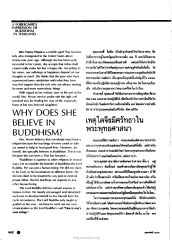
ความประทับใจของชาวต่างชาติที่มีต่อพระพุทธศาสนาในประเทศไทย
A FOREIGNER'S
IMPRESSION OF
BUDDHISM
IN THAILAND
Mrs. Nancy Hyson is a middle-aged Thai business
lady who immigrated to the United States about
twenty-one years ago. Although she has been quite
succes
lady who immigrated to the United States about twenty-one years ago. Although she has been quite successful in her career, she accepts that riches itself cannot really make her live a happy life. Acco

32
ความเชื่อในพระพุทธศาสนา
I HAVE NO RELIGION
REALLY. BUT I THINK
BUDDHISM IS THE
STRONGEST BELIEF I
HAVE.
๓๐ กัลยาณมิตร
Seeing his Inner
Body
On the first day of meditating,
the novice was not even able to
visualize a crystal
I HAVE NO RELIGION REALLY. BUT I THINK BUDDHISM IS THE STRONGEST BELIEF I HAVE. ๓๐ กัลยาณมิตร Seeing his Inner Body On the first day of meditating, the novice was not even able to visualize a crystal

77
การสังเกตในพระพุทธศาสนา
ต่อไปว่า
"Buddhism is not culture-bound. It
can moves very easily from one culture to
another. This is because Buddhism puts
emphasis on internal development rather
than on external development.
(พระพ
ต่อไปว่า "Buddhism is not culture-bound. It can moves very easily from one culture to another. This is because Buddhism puts emphasis on internal development rather than on external development. (พระพ

118
นิพพานในพระพุทธศาสนา
สนทนาธรรมยามว่าง
โดย ดวงธรรม
Nirvana is the Ultimate Goal of Buddhism
เป้าหมายสูงสุดของพระพุทธศาสนาคือนิพพาน
Tom : Hi, Rob, where will you go this weekend ?
Rob : Nowhere, I wish I could finish the Bu
สนทนาธรรมยามว่าง โดย ดวงธรรม Nirvana is the Ultimate Goal of Buddhism เป้าหมายสูงสุดของพระพุทธศาสนาคือนิพพาน Tom : Hi, Rob, where will you go this weekend ? Rob : Nowhere, I wish I could finish the Bu

119
การทำความเข้าใจเกี่ยวกับจิตและกรรม
Porn : According to Buddhism, it has four functions :
feeling, perception, mental formations, and
consciousness.
Jim : That sounds complicated.
Porn : In Buddhism, a creature, let's talk about a human
Porn : According to Buddhism, it has four functions : feeling, perception, mental formations, and consciousness. Jim : That sounds complicated. Porn : In Buddhism, a creature, let's talk about a human

180
พุทธศาสนิกชนที่แท้จริง
Chapter 41
A True Buddhist
When I reviewed my notes from a sermon given by a
respected senior monk during my research for this book, I
incidentally came upon a valuable message. That is, "What
is the
Chapter 41 A True Buddhist When I reviewed my notes from a sermon given by a respected senior monk during my research for this book, I incidentally came upon a valuable message. That is, "What is the
18
Understanding Dhammakāya and Theravāda Manuscripts
and is ‘spiritually reborn’. The dhammakāya becomes her new identity as the milk nourishes her spiritually. It is something she is given as a verbal teaching.
To add the material from the Apadānas is
This text delves into the doctrine of dhammakāya, representing a new spiritual identity that arises from teachings, akin to nourishment from milk. It connects the concepts found in the Agañña-sutta, i

48
ประวัติศาสตร์และการเปลี่ยนแปลงของพุทธศาสนา
ทำลายล้างพุทธศาสนาโดยชาตรีพรหมณและอินดในเวลาต่อมา พระเจ้าอโศกสุวรรณคตไปแล้ววา 50 ปี ชาติรีย์องค์สุดท้ายในรัชกาลนี้คือพระเจ้าพุทธทร ถูกแม่ทัพปุผู้ยิมิศรุ คุงคะ ปราบดาภิเษกแล้วตั้งรัชกาลณ์สุคคะ (185-73B
เนื้อหาว่าด้วยการทำลายพุทธศาสนาโดยกษัตริย์และพราหมณ์ในสมัยต่างๆ โดยเฉพาะช่วงหลังพระเจ้าอโศก ที่มีการกำจัดวัดและคัมภีร์สำคัญของพุทธ รวมถึงการแยกนิกายที่เกิดขึ้นในเวลาต่อมา สะท้อนถึงความขัดแย้งและวิวัฒน
83
Paleographical Analysis and Buddhist Manuscripts
Sander, Lore. 2000. “Appendix: A brief paleographical analysis of the Braāhmī manuscripts in volume I.” In J. Braarvig, eds., Buddhist manuscripts vol 1, pp. 285-300. Oslo: Hermes Pub. Original editio
This section presents a brief paleographical analysis of the Brahmi manuscripts in Buddhist texts as compiled by various scholars. Notable contributions include analyses by Sander (2000) on manuscript
61
Understanding Dhammakaya Knowledge
The Dhammakaya Knowledge is taught by the Buddha to constitute the transcendental, blissful, eternal, and pure Self of the Buddha. Dhammakaya doctrines can be found in the scriptures of all major Budd
Dhammakaya Knowledge is a profound teaching from the Buddha that emphasizes the transcendental, blissful, and pure nature of self. This concept is integral to all major Buddhist schools, including The
165
Exploring Concepts in Buddhism and Mindfulness
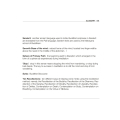
Sanskrit: another ancient language used in India; Buddhist scriptures in Sanskrit are translated from the Pali language; Sanskrit texts are used by the Mahayana school of Buddhism.
Seventh Base of th
This text delves into the significance of Sanskrit as an ancient language in India and its relation to Buddhist texts, particularly those influenced by the Mahayana school. It introduces the Seventh B
252
Exploratory Insights into Early Buddhist Texts and Practices
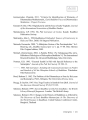
Jantrasrisalai, Chanida. 2011. “Criteria for Identification of Elements of Dhammikāya Meditacionds., Early Buddhist Traces of Dhammikāya Meditation : Project Overview.
Keenam P. John. 1982. Original p
This text presents an overview of significant scholarly works on early Buddhist practices and literature, focusing on the criteria for identifying elements of Dhammikāya meditation and examining the p

71
การสนทนาเกี่ยวกับธรรมกายและการปฏิบัติธรรม
LETTER
KANLAYANAMIT
YANAMIT LETTERS FROM KA
MIT LETTERS FROM KANLAYANAMIT LET
ROM KANLAYANAM LETTERS FROM KANLAYANA
AMIT LETTEF
FROM KAN
KANLAYAN/
IIT LETTERS/
OM KANLAY/
LETTERS FRO
AYANAMIT
LETTERS
KANLAYANAMIT YANAMIT LETTERS FROM KA MIT LETTERS FROM KANLAYANAMIT LET ROM KANLAYANAM LETTERS FROM KANLAYANA AMIT LETTEF FROM KAN KANLAYAN/ IIT LETTERS/ OM KANLAY/ LETTERS FRO AYANAMIT LETTERS FROM KA
4
Buddha Knows: A Journey into Buddhist Philosophy
Preface
While Buddhism was born and has prospered in the Oriental
world, blessing people with the teachings that guide them towards
happy lives and both mental and physical wellbeing, people from
the
In 'Buddha Knows', Monica Øien interviews Luang Phaw Dhammajayo, the abbot of the Dhammakaya Temple, as he addresses questions from the Western world about Buddhist philosophy. This book serves as a b